


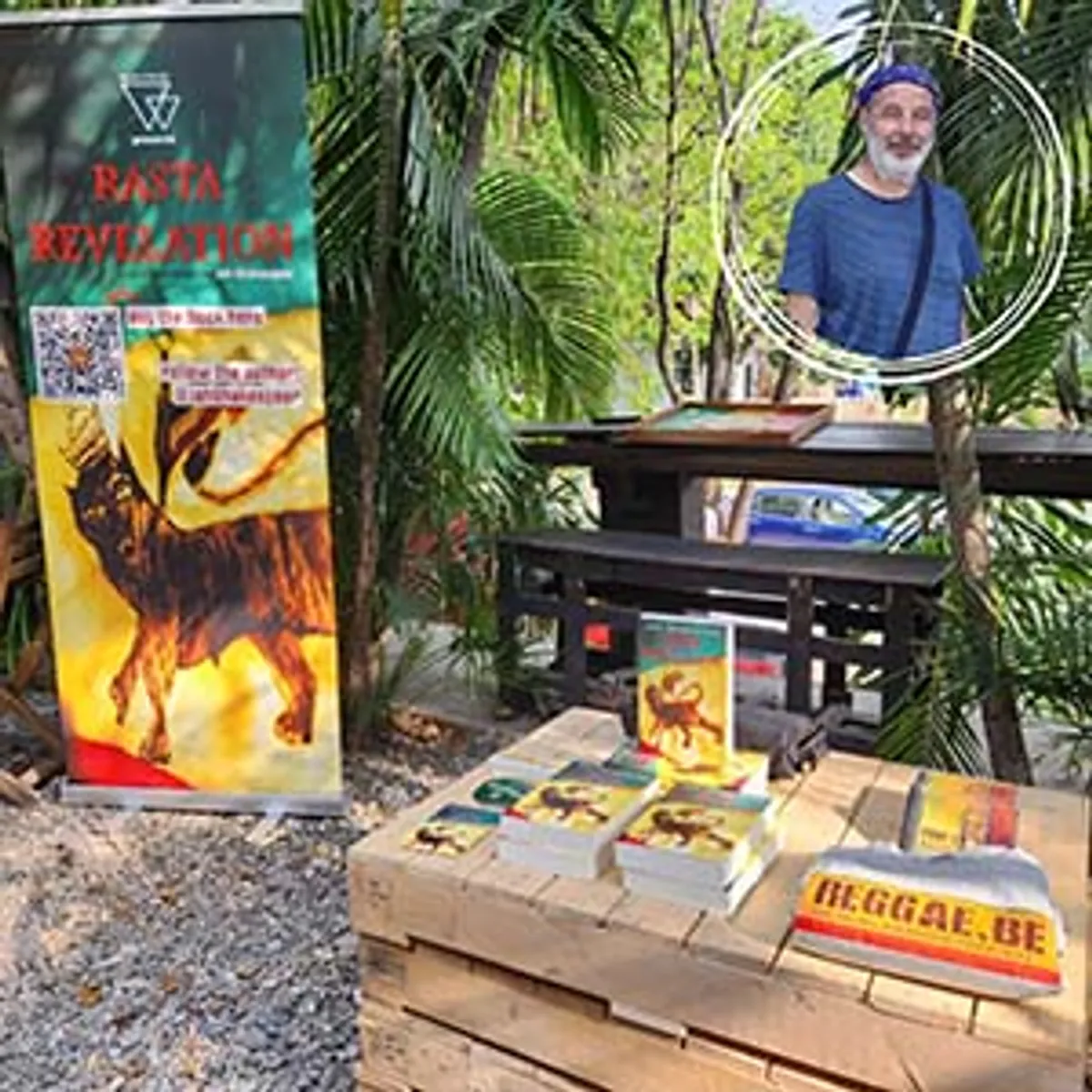
Jah Shakespear, accompanied by our marketing man Thomas De Beule, journeyed to Jamaica to promote the English edition of the book 'The Rasta Revelation'. It always feels a bit like a homecoming…
At the gate in Punta Cana, a man with his dog. After a nine-hour flight, we had to disembark here, pass through passport control, scan our hand luggage, and head straight to Gate 1. There was no time for a drink, let alone to wander through the duty-free shop. Most people have reached their destination, the Dominican Republic. Luxury and amusement just a stone’s throw from the hell Haiti has turned into, on the same island. We, however, are flying on to Jamaica, along with the holidaymakers who will return home from Montego Bay.
The man’s dog is cute, a small golden retriever obediently standing beside its owner. Then, an officer gestures for us all to line up, placing our hand luggage on the ground. This is a drug check, no matter how well-behaved the dog may be. But who would take ganja to Jamaica anyway? The dog and its owner patiently make their way down the line. Once they’ve passed us, we’re allowed to proceed, onto the airport, walking back to the TUI Boeing.

Somewhere in the back of your mind, you can’t help but hope the dog doesn’t smell that joint you smoked yesterday, or that there might have been a crumb of cannabis in your backpack at some point. But apparently, the dog wasn’t sniffing for that at all, as the taxi driver who awaits us at Sangster Airport in Montego Bay explains. It’s the cocaine trade thriving between the Dominican Republic and Jamaica. You’d have to be very quick and nimble to pick up a batch of coke in that short time, in that crowded place full of people and cameras, and then hide it. But I’m no smuggler.
Meanwhile, ganja in Jamaica is more freely and readily available than ever before. Even before we depart, Dane, our driver, immediately knows where he can score something for us. He returns with two round plastic containers with flip-open lids. This is how cannabis is sold now in the “ganja shops”, of which I intend to visit a few on this trip. One container holds the strain Wedding Cake, the other Platinum. The scandal bag, a piece of trash bag or other plastic in which ganja was usually sold on the street, seems to be a thing of the past, especially in the shops.
On the way, twisting, turning, braking, often pressing the accelerator deeply, in short: driving like most Jamaicans do, Dane encourages us to test the ganja. “Of course, you can smoke in the car!”, he exclaims: “I do it all the time!”. I recall the roadblocks from the past when only a hefty bribe could prevent the police from arresting you for drug possession. Today, you’re allowed to carry two ounces of cannabis in Jamaica, 56 grams. But are you allowed to drive “under the influence”? Once again, Dane responds with a questioning look: “Why wouldn’t we be allowed to smoke while driving?”
Reggae enthusiast since 1977, writing professionally since early 1980s for publications like De Morgen and De Standaard. Founded the website in 2002. Author of two books on reggae culture and history.
March 27, 2024