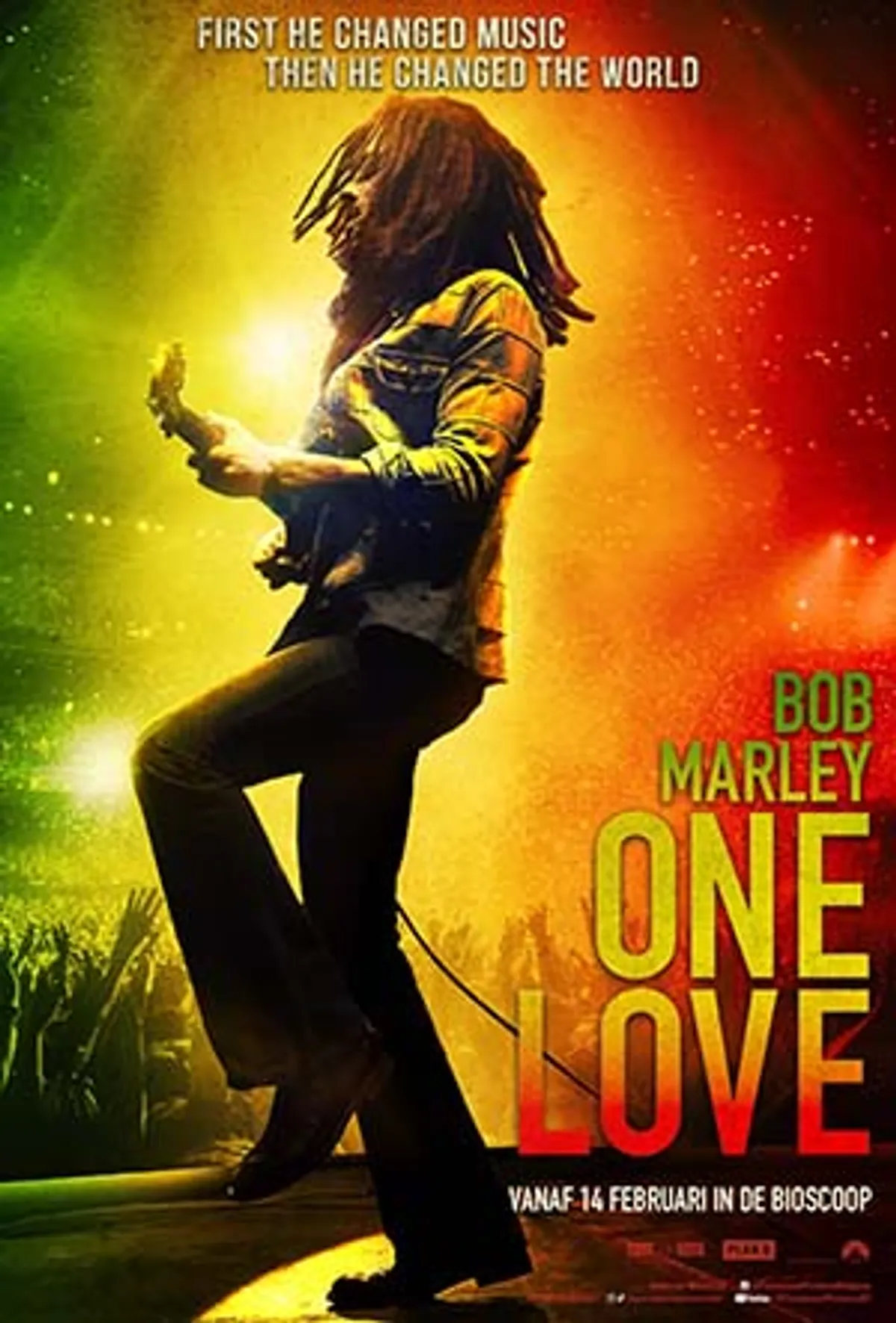
The reviews are not euphoric. “It does look a lot like a commercial for the Rastafarian movement,” a magazine wrote. There is something to that, too, and it agrees with what Bob Marley himself once said: that spreading Rastafari was his main mission. “The music and the message are one and the same,” lead actor Kingsley Ben-Adir quotes him in the film. And that translates into a mystical, underlying storyline told in dreams, visions and Bible quotes. If you don’t get those, or don’t want to get those (because of spiritual and rational incomprehension), much of the film’s power is lost. I wouldn’t call that a commercial but the successful artistic expression of a fascinating livity.
Not a bad word either about the acting of Kingsley Ben-Adir, who has previously featured as Barack Obama (series ‘The Comey Rule’) and Malcolm X (‘One Night In Miami’). The British actor, chosen by Ziggy Marley himself, has not only perfectly mastered Jamaican patois, as spoken throughout pretty much the entire film. He speaks like Bob, moves like Bob, dances like Bob and smokes like Bob (no real spliffs perhaps). I have yet to see a better Bob, even in the successful musical still running in London’s West End.
Who Is Mortimer Planno?
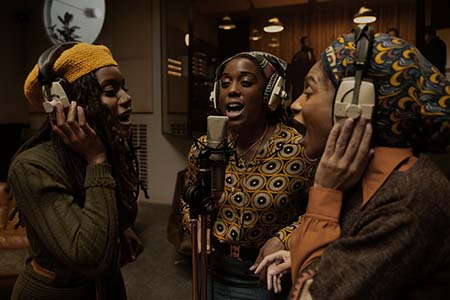
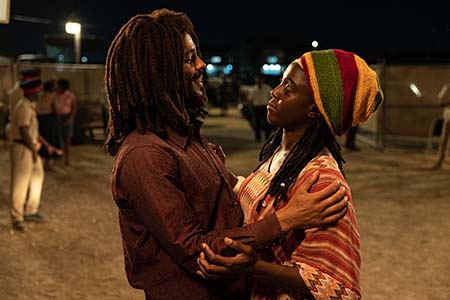
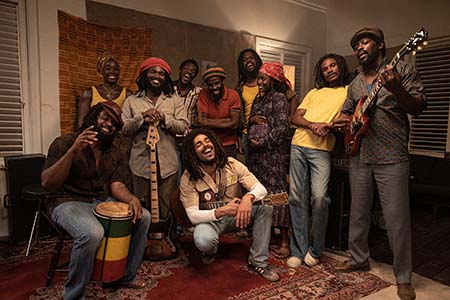
Lovely performance by Lashana Lynch in the role of Rita Marley (with singers Naomi Cowan and Anna-Share Blake aka. Sevana as Marcia Griffiths and Judy Mowatt, respectively), although her influence on Bob’s life and work is very much highlighted. For instance, she is said to have put him in touch with Mortimer ‘Kumi’ Planno, his teacher in Rastafari (played here by Wilfred Chambers aka Ricky Chaplin, also currently a guide at Bob’s birthplace in Nine Miles). Sounds plausible, if you know that Rita was in the front row when Haile Selassie visited Jamaica in April 1966, and swears (also in ‘Marley’, the brilliant 2012 documentary) that she saw in his hands stigmata, the wounds of Christ on the cross. None of this is told in the film, but anyway, Bob was then with his mother in Delaware, USA, working as a welder in a factory. So the euphoria of the imperial visit passed him by. His role model as a performer in those days was still the American soul singer Curtis Mayfield, usually dressed up in a tight suit, hair neatly cut. But before his departure abroad, wasn’t Bob Marley a familiar face at Studio One? And hadn’t he worked there with the Rasta men of the The Skatalites, Jah Jerry and Johnny ‘Dizzy’ Moore? Could it really have been Rita Marley who introduced him to Planno and his companions, then disdainfully called Dirty Dreads?
”Her dreadlocks prevented the bullet from piercing the skull,” says someone after the attack on Marley’s life in 1976, the film’s most exciting and dramatic moment. Bob was slightly wounded, Don Taylor took a bullet in the chest, Rita in the head. Fortunately, then, she had life-saving dreadlocks.
Rita explains to Bob what ‘I and I’ means. Mmm… Rita told him the story of the Biblical figure Joseph (not Mary’s lover), with whom many identified Bob. Rita slaps Bob for being jealous. Rita helps him when Bob doubts himself. Rita thinks Bob wrote ‘Turn Your Lights Down Low’ for her after all, and not for Cindy Breakspeare, the then Miss World and mother of Damian ‘Junior Gong’. That neither of them was present at the premiere, while Rita Marley was given a place of honour, is causing heated gossip and debate in Jamaica.
The Crown Prince’s Ring
But enough about Saint Rita. Even if you have nothing to do with mysticism and Rastafari, but do like reggae and Bob Marley, there are enough delights in the film to keep you enthralled. Little Bob on the bus on the way to Kingston. Little Ziggy and Stephen in the house on Hope Road, where
Mutabaruka turns out to be the guard or gatekeeper. The authentic nyahbinghi session. The Ethiopian crown prince’s ring. Where was Bob on July 7, 1977, when two sevens clash? My favourite line from one of my favourite Marley tunes, ‘Guiltiness’: “…they’ll eat the bread of sorrow…”. The best opening line ever: “One good thing about music, when it hits you feel no pain!”. The Amharic letters on the cover of the classic album ‘Exodus’, which is central to this film, and the discussion about it with the marketing department. The rejected cover that Neville Garrick had made earlier.
Most of the film is set in London. “Dem a rebels,” Bob says of the punks seen there at a concert by The Clash. He is arrested for having a petite spliff in his hand. The riots in the London streets remind him of the riots in Kingston.
We witness the creative process of the songs ‘Exodus’ (inspired by the epic film and soundtrack of the same name about the Jewish migration to Israel after World War II) and ‘Natural Mystic’, in scenes that make a very truthful impression.
Lee Perry, Coxsone Dodd’s Crazy Sidekick
A blissful flashback takes us back to the days of Studio One in the mid-1960s, for the recording of ‘Simmer Down’. Coxsone Dodd is depicted as a trigger-happy patsy, which is probably not a historical inaccuracy (it was Treasure Isle’s Duke Reid walking around with a gun), but poetic imagination. It is also the only scene in which Lee ‘Scratch’ Perry appears briefly, as Dodd’s crazy sidekick. His minor role is played by
Everaldo ‘Evie’ Creary of No-Maddz, hyped just under a decade ago as the future of dancehall and reggae.
Abijah ‘Naki Wailer’ Livingston takes on the role of his father Bunny, but he too is assigned no more than a silent extras role. The otherwise unknown to me
Narado Williams is the young Peter Tosh.
From London, Bob Marley & The Wailers (with
Aston Barrett Jr. in the role of his recently deceased father Familyman) also go on tour. Suddenly, we see them in Brussels, and numerous other European capitals. In Paris, they appear at a posh record company party, “whining and dining” Rita disparagingly calls it, and it is indeed a very different world the Jamaicans enter there. If only because sterile disco reverberates amidst all those fantastic classics in the rest of the film: ‘Roots Rock Reggae’, ‘Lively Up Yourself’, ‘I Shot The Sherrif’ (famous jam in the house on Hope Road), ‘No More Trouble’, ‘Jammin”, ‘No Woman No Cry’ (addressed to Rita, of course), ‘One Love’, ‘Redemption Song’ (whose theme is also in the accompanying music), ‘Three Little Birds’…
In a rare furious moment, Bob Marley beats up his manager, the man who saved his life a few months before. Marley was only human too, and this film is by no means a hagiography. Except perhaps in the recurring dream, which ultimately turns out to hold the key to his unconditional surrender to Rastafari.
Pardon?
One of the highlights of the film is the live performance of ‘War’ at the Smile Jamaica concert, barely two days after the attack. I expected another splashy finale at the end, the One Love Peace Concert after Bob’s return from voluntary exile, where he brought political rivals Edward Seaga and Michael Manley together on stage and blessed them in the name of Rastafari. But that memorable event is not in this film. There have already been enough documentaries about that, the original footage is widespread.
In the run-up to the One Love Peace Concert (which is not in the film), Bob Marley pardons one of the gangsters who put him under fire. Anyone who has read Marlon James’ award-winning ‘A Brief History Of Seven Killings’ will know better. But I grant Bob saint status, much more than Rita. Bob made no secret of the fact that he was good friends with top criminals like Claudie Massop and Bucky Marshall, who also had links to the island’s two major political parties. Rebellion, politics and crime were hardly distinguishable in Jamaica in those days.
In Jamaica, ‘Bob Marley: One Love’ was filmed in locations that have barely changed since the 1970s: Trenchtown, Hope Road, the enchanting Blue Mountains… One of the most beautiful scenes is an authentic nyabinghi, as the Rastafarians call their ritual gatherings. It all adds to the authentic positive vibrations this film exudes, carried by a strong, credible cast, in an integer direction by
Reinaldo Marcus Green (‘King Richard’, ‘Monsters And Men’). With a fantastic soundtrack, of course, the many timeless songs perfectly linked to the events.
Ziggy Marley, the driving force behind this film (with
Brad Pitt as executive producer!), says it himself: Kevin McDonald’s documentary ‘Marley’ (2012) is and remains the ultimate portrait of his father. But for those who want to get to the bottom of the almost mystical bond between Bob Marley and Ras Tafari (as the Ethiopian emperor Haile Selassie used to be known), there is now this surprisingly intimate biopic. The film is peppered with references to the Bible and Selassie, as they determined not only Marley’s spiritual thinking but also much of his song lyrics. And didn’t he himself say that his main mission was to spread Rastafari? “The music and the message are one and the same,” lead actor Kingsley Ben-Adir quotes him in the film. Jah live!
Photos: © Paramount Pictures