


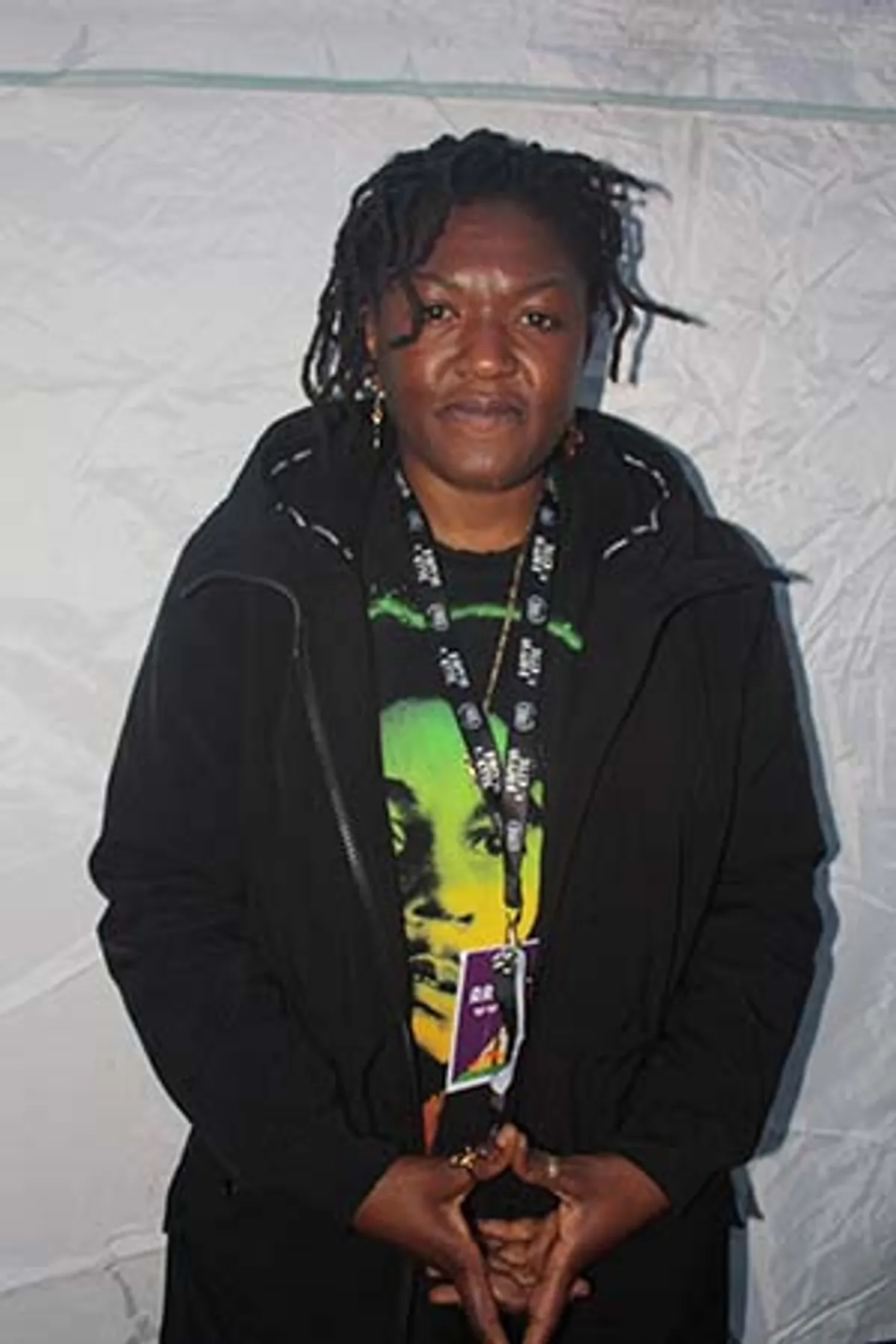
De meesten van jullie zullen ongetwijfeld al aan het aftellen zijn naar de jaarlijkse hoogmis van de reggae in Geel volgend weekend, maar we maken jullie toch graag nog even warm voor Helden in het Park in Eeklo, waar nu donderdag deze Nadia McAnuff ten dans zal spelen!
By Jah Rebel
Nadia, I think, the first time I crossed your name, it was as a backing vocalist for Inna De Yard or one of your dad’s tunes. I’m not exactly sure which…
Nadia McAnuff: “The first time we met, I think I was doing backing vocals for dad and I was drumming, because I drummed on a few tracks from the last Inna De Yard-album.”
But then I discovered that there has been a previous EP, somewhere around 2008, with a project called Agape, I believe?
Nadia McAnuff: “It’s called Agape featuring Nadia Harris, and Eric Paredes and I are the founders of that band. He’s my first producer, and when I met him we started working on some songs together and then we started a band called Agape featuring Nadia Harris in Miami and we’ve been doing that for 20 years now. With Agape it’s more like neo-soul, funk, dub, jazz, drum & bass, you know. And I drum, but not only nyahbinghi, I also play the djembe and I do some producing. It’s a collaborative effort. But while were working on that, I decided that I wanted to connect more with my roots. So then I went to Jamaica and I started working with my dad and my brother, Kush McAnuff, and Inna De Yard, Linval Thompson and a lot of different producers.
You’re also a cook.
Nadia McAnuff: “Yeah, I’m a vegan chef, as well. My mom taught me how to cook from a very young age. I’ve been cooking from when I was six years old. So from that age, I’ve been coming up with different recipes. And when I turned 12, my mom opened a little restaurant called Fatih’s Variety Shop next to our house. She told me: “You’re 12 years old and you’re in school, but if you want to cook in the restaurant, you can, no problem!”, so I started making pies, ital stew, rice and peas, and so on. I sold a lot, and that’s when I was like: Okay, that’s another profession I’m going to take on!”. My mom was always there to push me in whatever way, in whatever I decided to do, because she always told me that I could be whatever I wanted to be, and that just stuck with me.”
At which point in your life did the musical side of things get the upper hand?
Nadia McAnuff: “The musical side has always had the upper hand, because I was raised in the mountains with my mom and my brothers, and that’s where I kind of cultivated my love of not only singing but drumming as well. I’ve always loved drumming and singing equally. My love for music and rhythm started at a very young age. I started reading when I was only three years old, and actually taught myself how to read by using the Bible. I remember just being really confused and looking at the words and just looking at everyone else reading and just really wanting to be able to do that myself. I actually prayed to be able to read, because my mom taught me how to pray at a very young age, you know. So I prayed and I prayed, and one day I opened the Bible and just started reading Psalms 23. I just started reading the whole thing. I called my mom and I was like: “Mom, Mom, Mom, I can read, I can read!”. After that, I started reading songs from ‘Sacred Songs and Solos’, which was the hymnal we learned our songs from at school, the hymnal. I also never stopped singing. In everything I did, when I was happy, when I was sad, my mom said I would always be singing! Before I even started singing, I’d noticed that everything had a sound. Every move I made had a sound: the rain, the birds, washing the dishes, washing your clothes… I realized that everything was sound, but the loudest sound I ever heard was silence. Because even in silence, I hear a lot of layered sounds!”
In the press, you’re sometimes described as having a punk attitude or that there’s a jazz flair in your voice. Can you find yourself in these comments?
Nadia McAnuff: Yes, I can, because, I’m into a lot of genres. I love roots, it’s like a part of me, but plenty of other genres have a room in my house as well. So sometimes I might sound like Nina Simone, other times I might sound like Edith Piaf, and on another day I might rather sound like Marcia Griffiths. When I open my mouth, to sing or to speak, the essence of music, the essence of jazz, the essence of Queen Omega, the essence of love, is what comes out. A lot of people see different sides of me, and try to put it into words, but in reality, I’m like a melting pot… If you could see what’s going on in my mind, or feel what’s going on in my heart, you’d understand. You know. But for now, we use words.”
I heard you mention your mom several times now. So, the logical follow up question would then be what role your father, who’s a well-known artist, played in your musical upbringing?
Nadia McAnuff: “From when I was a child, my dad was always on the road. So a lot of us didn’t really get to spend a lot of time with him. The COVID-19 pandemic really gave us the opportunity to spend a lot of time with dad for the first time in a long while, you know. But my mom would always play my dad’s music. And she would always talk to me about my dad, so that I would know that what I’m feeling came from him. Whenever my dad was not touring, he would come and see me, and bring me little things. He’d play the drums and sing with me. He would always encourage me never to stop: “Just continue, Nadia. Just continue working on your craft!”. I would say that’s the role he played. It wasn’t a big one, but it meant a lot, because just me being born from him and my mother, kind of gave me that guidance, you know. But predominantly, I spend most of my time with my mother, so even in my songs, you’re going to hear me talk about my mom.”
I also got to meet your younger brother Matthew, who’s sadly no longer with us. What was your relationship with him? And how did you deal with his sudden demise?
Nadia McAnuff: “Whenever I went to visit dad, Matthew wouldn’t leave my side. He and I are the singers in the family, so we’d always be singing together. Before he passed away, he was in France with Inna De Yard. He kept on asking me to come and I didn’t, I was busy in my world, doing my thing. Three days before my brother passed away, I had a vision. In the vision I was rising to the heavens, passing the ozone layer, becoming a body of gold, and landing on the moon. When I’d landed on the moon, there were seven other people there. A woman came out of a glass observatory and she brought us inside. She said: “On this planet, the sun shines for three hours and you have to be inside before it sets.”. When I woke up, I called Jamaica and said: “Kush, I think I’m going to pass away!”, and Kush replied: No man, you’re not going to pass away, no way!”. I said: “I think something’s going to happen. Where’s Matthew?”, and he replied Matthew was in Montego Bay. They had to leave him in Montego Bay because they just performed with Capleton and the car couldn’t hold them all. I started crying, and was like: “No! No! No! You need to go get Matthew!”, and he was like: “Nadia, he’s a big man, You know. I can’t really tell him what to do!”. Than after that vision and my whole discussion with Kush I got home, and my son said: “Mom, sit down please.”. I asked: “Why?”. My son told me that my brother had passed away… They found him, laying under a tree, looking up to the heavens. I just cried… It was the hardest thing. My brother, my grandfather, and Prince Emanuel, were the three hardest deaths in my life. If I tell you now, that I’ve gotten over my brother passing away, I’d be lying. I don’t think I’ll ever get over it. I really regret not having Matthew here with me. Every time I’m on stage, I see him, laughing and singing. I hear his voice. Matthew came here to do something, and he touched each and every one he met. Rest in peace my brother, rest in love and light. We’re here, doing it for you!”
You just mentioned the COVID-19 pandemic there. I think it’s fair to say that the whole collaboration with the Ligerians also stemmed from that same period.
Nadia McAnuff: “Yes, it did. It did. I actually started writing some songs with Linval Thompson, and then he told me about The Ligerians. I think The Ligerians contacted Linval and said they would like to link with me. Linval told me: “Hey man, I love The Ligerians. They’re like my brothers, man. I love it when they back me. The Ligerians have this energy, this really strong roots energy that we love and appreciate!”, and he gave me their number. Then I spoke to Gabriel, and we started working on ‘Lockdown’. From there we started working on the EP. We did everything during the COVID-19 lockdown and it was released in 2022. We started touring together, and this is now our second year touring together.”
You already mentioned how instrumental drumming and nyahbinghi have been and still are for you. Now, you’ve got this song called ‘Order’, which features nyahbinghi drumming, but is also a big statement, a bold statement even, on the role of women in the Rastafari movement. On a personal level, how have you dealt with that side of things?
Nadia McAnuff: “Well, it’s still taboo to many, you know. I was raised in the Bobo Shanti order, and women weren’t allowed to play. So, I taught myself how to play the drums, and I watched for 14 years how other bredrin played the kete, the funde and the bass. I never understood why I couldn’t play. I knew that we were living within the Bobo Shanti order and I had to follow the rules. So, what I would do is I would play on everything! And then I started reading, and I started learning more… About the role that the drums played in the culture of my people, about Queen Nyabinghi. She was a woman who led a revolution in Africa and used drums to send messages. A lot of rasses still put me down and look down on me, just because I play the drums. They claim it’s not my place. So, it’s been a struggle. But for me, the drum is like the heartbeat, and what would we be without the heartbeat? That’s how it makes me feel. For me, it’s the rhythm of life. So, what I do now, is I just play it, and I don’t let anyone tell me not to. I also try to teach it to as many empresses as I can, to those who are willing, and brave enough to take it on!”
Foto: © Fabrice De Smedt
Medeoprichter naast Jah Shakespear die eind 2014 naar deze rol overstapte. Werkte eerder als criticus en verslaggever, waarbij passies voor muziek en Haile Selassie-spiritualiteit in balans werden gehouden.
July 31, 2024