


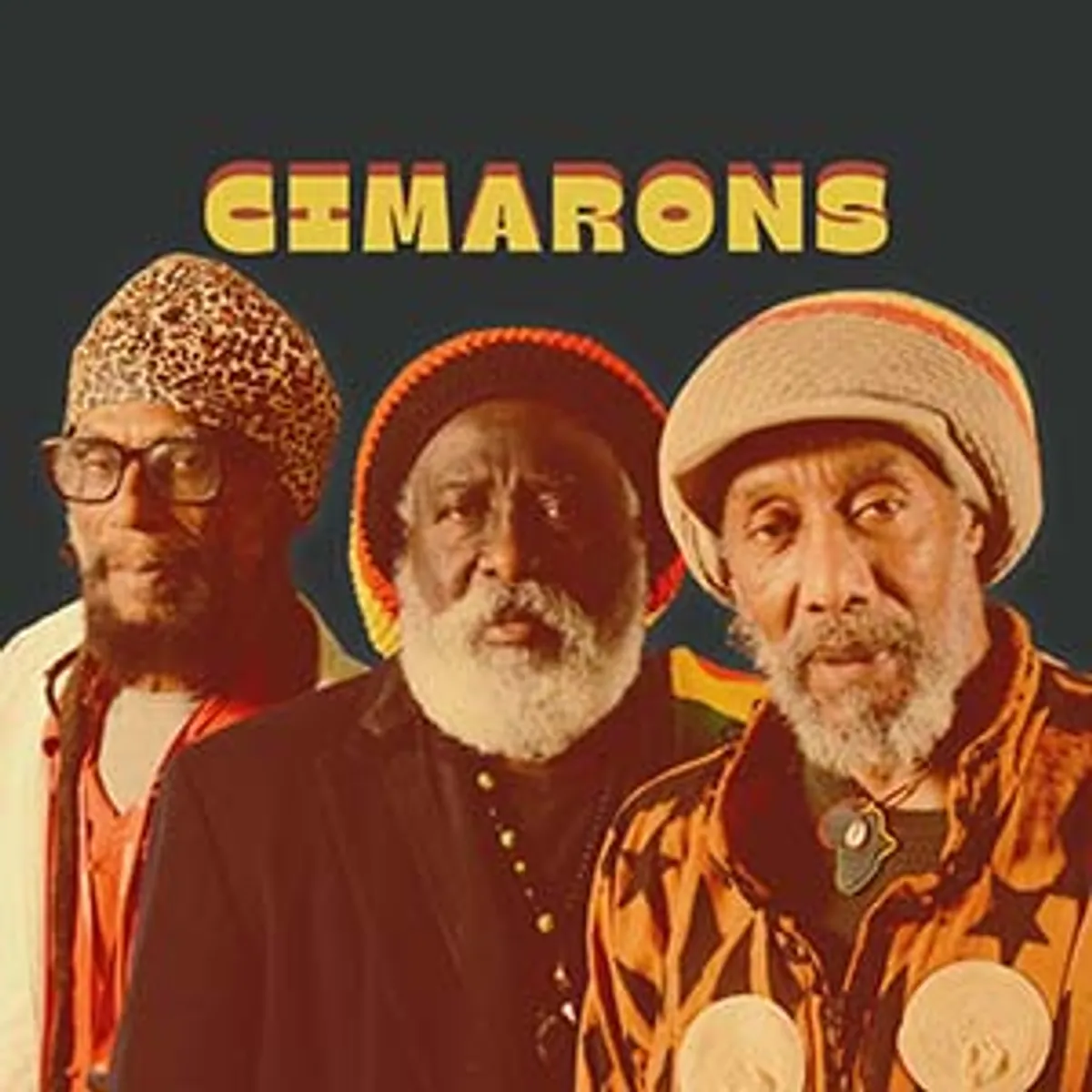
De Londense reggaepioniers van de Cimarons lijken aan een heuse comeback bezig, want na het eerder dit jaar verschenen 'Harder Than The Rock', een bejubelde documentaire over het haast onwaarschijnlijke verhaal van de Britse band, werken ze nu ook hard aan een nieuw album.
By Jah Rebel
De documentaire was vooralsnog niet te zien in ons land, maar Cimarons-oprichter en gitarist Locksley Gichie wilde maar al te graag de opmerkelijkste feiten uit de geschiedenis van de band met ons delen. Het werd een lang en interessant gesprek dat we hier voor de goede orde opsplitsen in drie delen.
Zoals gezegd werken de Cimarons ook aan een nieuw album. Voor de opnames reisden ze al af naar de A-Lone Ark Muzik Studio van Roberto Sanchez in Spanje, maar ze kunnen nog wel een financieel duwtje in de rug gebruiken, en we willen jullie dan ook warm oproepen om de Kickstarter-campagne, die nog een kleine twee weken loopt, mee te ondersteunen!
Locksley Gichie (guitar): “I moved to Harlesden in London back in 1962 at the age of about twelve or thirteen. I was still in school, but really wanted to be a singer. It was around the time of the Jamaican independence and the whole ska thing had just taken off. At first I wasn’t really into it, but when I heard ‘Simmer Down’ by The Wailing Wailers, and even more ‘Dancing Mood’ by Delroy Wilson, I was blown away! When that song came out in the UK, I remember going to this club called the Cue Club (later the Q Club, in Praed Street, Paddington, red.) which was owned by a sound system man called Count Suckle, and danced the night away!
At that time there weren’t much black performers or groups around. You only saw them on television programmes like Ready Steady Go! or Juke Box Jury, featuring mostly British artists with a couple Americans thrown in for good measure! So when I found out there was a black British band called The Shadrocks, I simply had to check them out. Now in those days you had the 31 Club in Stonebridge, near where I lived. It was one of the only clubs playing black or even Jamaican music in those days. The Shadrocks used the place to rehearse. I went over there and talked to the lead vocalist, expressing my desire to become a singer as well, but he simply told me to buy a guitar and start my own band.
As at that time I couldn’t play guitar yet, his advice came a bit like a slap in the face, but a couple months later I still purchased my first acoustic guitar! (laughs) I didn’t have a clue though and probably was even holding the thing all wrong! (laughs) It got so bad that I decided to quit and put the guitar away again, deciding this wasn’t going to work out for me. Then one night a friend of the family passed by and he saw the guitar in the corner, asking me if I played. I denied, but he picked it up anyway and noticed immediately that it needed some tuning. He showed me how to, and even taught me how to play my very first chords.
Suddenly this whole guitar playing thing felt like it came natural to me! At one point I felt I’d become good enough to take part in a singing contest, performing the song ‘My Girl’ by The Temptations. On the night, I was thrown into the deep end straight away, no time to rehearse or anything. I barely knew what I was doing and the whole experience was dreadful! However, it didn’t discourage me and I kept practicing.
Meanwhile the music had started to change from ska to rocksteady. One rainy Friday evening I was walking home from work, and suddenly I noticed this bredrin carrying a guitar sheltering from the rain outside a Wimpy’s Burgers joint. I immediately crossed the street and asked him: “Hey brother, can you play the guitar?”, and he replied: “Sure bredda!”. We started talking and eventually decided to meet up at the local youth centre the following Friday. That’s when I first hooked up with Frank (Franklyn Dunn, bass, red.)!
The two of us found ourselves a room in the youth centre where we could practice, and we started getting together every Friday night onwards. Franklyn eventually switched to the bass. Then one day this bredda we didn’t know walked in, listened to us play for a while, and eventually introduced himself as Levy (Carl Levy, keys, red.), telling us he could play the piano. It just so happened that downstairs in the hall of the youth centre there was a piano, so we took Carl down there, and sure enough… Then Maurice (Maurice Ellis, drums, red.), who was a bit more musically savvy then the rest of us as he had been in a school marching band, joined us, and we had the nucleus of a real band! As a vocalist, in those days we had a bredda called Mingus, a soul man and a mean Otis Reading impersonator. Even though the rest of us really wanted to play rocksteady, we still made do as the whole band thing was nothing more than a hobby project at that time.
One day though, Frank came by my house and took me to a local music shop, telling me: “Time to buy some music equipment!”. I was a bit reluctant, as I couldn’t really afford it, but Mr. Melbourne, the owner of the shop turned out to be a real nice individual. He just looked at what we wanted to purchase, took us to the back of the shop where he kept his second hand equipment and gave us a deal where we had to pay him in 50 pence instalments. In those days, that was still a bit of money, but we gave him a two pound deposit and agreed.
Up to that point I’d just been playing my acoustic guitar, so I basically had to start learning how to play this electric guitar from scratch! But I took to it faster than I would have given myself credit for. I’d bought myself a book that had 2000 guitar chords in it, and after about a week I had already mastered about 100!
Now Maurice and Carl were passionate cricketers and when the local cricket club was holding a dance, they proposed we play there. When we played the gig, the crowd went absolutely crazy… Not only were we the only band in the UK playing rocksteady, but we also played tunes that had freshly come in from Jamaica!
From there we moved on to a proper big club in the west end called Whiskey-A-Go-Go (33 Wardour Street, Soho, red.). When we got down there I was so nervous I was in tears, but we played a brilliant show none the less. There was a brother in the in the audience who lived in Bristol and he asked us wither we’d be interested in playing in a club of a friend of his called The Bamboo Club (7 St. Paul Street, a now iconic venue, that played a pivotal role in the history of the West Indian community in Bristol, red.).
At that time we were still trying out various names for the band, but at one point I came up with Cimarons. In those days you had an American television series called ‘Cimarron Strip’, a western style show a bit similar to ‘Bonanza’ or ‘Gunsmoke’. We just spelled it slightly different! (laughs)
We started doing regular gigs in clubs in Bristol and Leeds from 1968 onwards, but we really weren’t taking it all that serious still, until one night this Nigerian brother called Eddie Ugbomah came up to us and expressed his desire to take us on tour in Africa! At first we didn’t take him too serious, but he started asking us if we could also play soul as at that time in West-Africa people liked American soul and rhythm-and-blues artists like James Brown and Wilson Pickett. He was especially adamant we should be able to play ‘The Champ’, a hit tune by a band called The Mohawks that had just been released by the newly established Pama Records label (based on the Lowell Fulson soul blues classic ‘Tramp’, and created as a tribute to the late Otis Redding, this Hammond infused dance groove went on to be one of the essential hip-hop samples of all time, red.), and even suggested we change our band name to Soul Messengers! We weren’t too happy with it at first, but eventually we went along.
When we set out for Africa, Eddie first took us to Ghana, where we played the hotel circuit. Now in the UK we were used to do one hour sets, but in Africa the people weren’t having none of that, so we just had to keep playing! (laughs) By that time Mingus had left the band and we’d gotten a new guy in called Patrick Guy or Legs as we called him. He wasn’t a great singer, but he could do soul and was a good dancer.
Financially, the trip was a bust though, cause Eddie turned out not to be a very trustworthy guy. Basically he was just a con man! We were supposed to fly on to Nigeria from Ghana, but in the middle of the night Eddie came knocking on the door of our hotel room, telling us to grab our things as we had to go! We ended up sneaking out of the hotel, crawling over some fences and walls, making our way to the main road, where a big estate car was waiting for us.
We had to drive all the way from Ghana to Nigeria by road! But you have to realise this was also the time of the Biafran War (a civil war fought between Nigeria and the Republic of Biafra, a secessionist state which had declared its independence from Nigeria in 1967, red.), so when we finally got to the border, there was a queue for miles as the military were checking all cars from top to bottom! Eddie had the driver pass the whole queue, until we were finally stopped at gunpoint. Eddie kept his cool though and ended up bribing the guy in charge, a fellow called Gypsy, with a few signed records.”
To be continued…
Cofondateur aux côtés de Jah Shakespear qui a transitionné vers ce rôle fin 2014. A précédemment travaillé comme critique et journaliste, équilibrant ses passions pour la musique et la spiritualité Haile Selassie.
December 3, 2024