

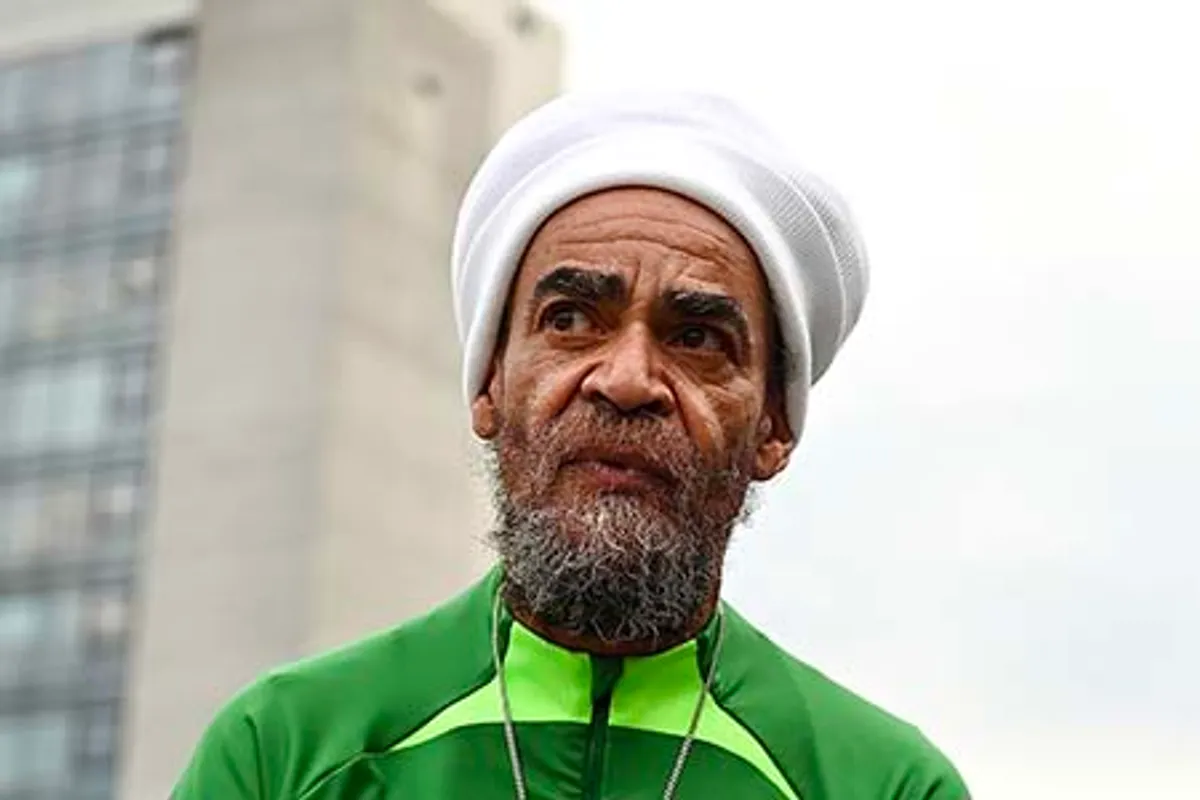
Op zaterdag 16 maart is Brother Culture samen met Little Lion Sound te gast op de jaarlijkse Lee 'Scratch' Perry tribute in de Vaartkapoen. Vorig jaar zette de Londense MC zijn veertigjarige carrière nog in de kijker met de release van zijn '40th Anniversary Collection', een compilatie met een overzicht van 's mans beste werk. Wij blikten dan ook graag even met de man terug op zijn begindagen in de Londense reggae- en dubscene en zoomden in op enkele plekken en personen die een speciale betekenis voor hem hebben.
By Jah Rebel
Brother Culture, you’re celebrating a reggae career that spans four decades now, but how exactly does a youngster of Nigerian-Irish decent end up in the London reggae scene?
Brother Culture: “Well, for that we have to return to 1974, when my mum showed me a copy of National Geographic Magazine featuring an article about Haile Selassie. It kind of got stuck in my mind… My father is an engineer of Nigerian decent and my mother was Irish. They met in 1950s London and I ended up becoming the youngest of seven. My dad always wanted one of us to experience school in Africa, so I attended school in Nigeria from 1978 to 1981, and while I was in Nigeria, my uncle, who I was living with, took me to my cousin’s to watch a film called ‘The Ten Commandments’ (Cecil B. DeMille, 1956, red.) starring Charlton Heston. When we arrived at the cinema in Lagos, the movie was sold out and the only other one that we still could get tickets for was ‘Reggae Sunsplash’ (Stefan Paul, 1979), a music documentary about the 1979 edition of the Reggae Sunsplash festival in Jamaica. I quickly got captivated by the film as it brought back memories of these pictures of His Imperial Majesty in National Geographic my mom had shown me years before. Back then, I used to come back to London every summer, to spend the holidays, and that particular summer, three of my five sisters had turned to Rastafari. Under the name of Sister Culture, one of them had also started MC-ing for Jah Revelation Sound from Brixton, which at the time was the official sound system for the Twelve Tribes of Israel movement. I was so impressed with what I’d seen in the documentary and with what I was now witnessing first hand with my sisters, that I told my parents I didn’t feel like returning to Nigeria again to continue my studies. I started hanging out with my sister as she was MC-ing, and as is often the case in reggae, I got a nickname quite quickly. Since my sister was known as Sister Culture and was her younger brother, people started referring to me as Brother Culture. I started MC-ing on Jah Revelation myself in 1982, and from there everything just progressed naturally.”
Did you start MC-ing straight away?
Brother Culture: “No, not really. I joined Jah Revelation and the Twelve Tribes movement almost simultaneously and initially I just used to lift the speaker boxes. My main task was looking after the cassette tape though! (laughs) In those days we used to play dances from midnight to six in the morning and we recorded the whole session on cassette tapes. But since they only had a duration of sixty minutes, it was my responsibility to turn the tapes over in time, so the recordings would sound linear afterwards. I’d signal the selector and he’d pull up the record that was playing and start it again, so on tape we ended up with one continuous mix. I was fortunate that my sister was one of the top MC’s for Jah Revelation - at the time she was working with people like Aswad, King Sounds And The Israelites and Sir Coxsone Outernational - and that made things just that little bit easier for me to climb to the ranks of MC. That being said, I honestly have to say I also was given this talent and nobody sounded like me, not even my sister. You could say, I was the first UK-born MC, as the MC’s who came before me were mostly Jamaicans who’d migrated to the UK. Myself, Tippa Irie, Papa Levi, Smiley Culture… we all came from that same South-London school of MC-ing.”
Let’s return to Twelve Tribes for a moment. What did you take with you from your time with that movement, what does it represent in your life?
Brother Culture: “As far as I’m concerned, Twelve Tribes was the Rasta doctrine that set me on the path to where I am today! I’ll never forget the teachings I got from people like Prophet Gad, the founder of Twelve Tribes, Cecil Reuben, who’s the manager of Jah Revelation, and many others. Even though people now know me as an international artist, I still hold those same Twelve Tribes teachings dearly. I’m not a practicing Twelve Tribes member anymore, but I can never forget that it was through that movement that Brother Culture saw the light.”
You just mentioned no one really sounded like you at that time, so who were the vocal examples you listened to and looked up to yourself?
Brother Culture: “I used to listen to people like Brigadier Jerry, Lone Ranger, Clint Eastwood & General Saint, and then there were local London MC’s like Prince Naphtali and a lot of the MC’s from Sir Coxsone Outernational and Saxon Sound, who I was close friends with. I went to school with some of the members of Saxon Sound and lived on the same housing estate as quite a few members of Sir Coxsone. I hung out with people like Jah Screechy, Bikey Dread and Tenor Fly, who was a little bit younger than me, but kind of started out at the same time I did.”
Recording-wise, I think it’s fair to say that over the years you pretty much worked with just about every reggae and dub producer in the UK, people like Nick Manesseh, Zion Train, Vibronics, Adrian Sherwood, Mungo’s Hi-Fi, the list goes on and on.
Brother Culture: “Yeah, and I’ve always been lucky that they’ve never tried to steer me in a certain direction or try to tell me how to MC. The thing was though, that working with so many different producers also meant they didn’t always have my interest at heart. Not in a bad way though… They were just dealing with their own thing, using my voice and style as a means to an end. I think I’d have to say Mad Professor might be the big exception to the rule there, as he’s given me loads of life and work experience. These days I’m mostly working with Little Lion Sound from Geneva in Switzerland, and in the years we’ve been collaborating he’s provided me with a platform that allows me to put out consistent records and redirected my focus on album instead of single releases. He’s also aided me a lot in the administrative department of my music, allowing me to reap the benefits from my recording work. All these years I was working with all these big UK producers, I still ended up being broke! I now made three albums in a row together with Little Lion (‘Code Name’, ‘12 Lights’ and the compilation album ‘40 Years Anniversary Collection’, red.), and so far it’s been a great journey!”.
I’d like to present you with a quote from an older interview if I may, in which you stated: “I learned the rules of the jungle too late and I’m having to play a lot of catch up!”. Could you elaborate on that?
Brother Culture: “Well, I feel I’m still not always given the credit that I’m due. Maybe not so much on the continent, as in Europe I get to play on the biggest festival stages, but in the UK it’s still another matter. Not because I’m not a good MC, but mostly because of personal issues with promoters who are quite influential and can boycott you quite easily if they want to. But, that being said, I’m a lot happier and more comfortable these days, then I was back when I said that! (laughs)“
In 2011 you did an EP called ‘City Of Vibes’, produced by Kinyama Sounds. They’re also a Swiss-based sound, so I was wondering if this was perhaps your first introduction to the reggae and sound system scene over there, eventually leading to your collaboration with Little Lion Sound and the Evidence Music label?
Brother Culture: “Not exactly… I first started to go to Switzerland with a guy called Jahlow, who ran a sound system in Annecy, right across the border in France. It was through working with him that I met the members of Kinyama Sounds. The EP we did together was great, but it wasn’t really given the promotion it deserved and I remember ending up in a huge argument with them about it, so that was that. But then there was also my collaboration with Teddy Dan, who’s since migrated to Shashemene in Ethiopia. In the early nineteen nineties he was working with Asher Selector who had a label called Roots Man Records. I used to have a small record shop in Brixton and Asher used to come over to London and visit. So, long story short, I guess you can say my connection with Geneva and Switzerland goes way back!”
There’s one collaboration we definitely still have to mention, especially because it’s outside the beaten track of reggae and dub, and that’s your relationship with The Prodigy. How did that originally come about?
Brother Culture: “I met the guys from The Prodigy through a guy called Andy Smith, who’s a selector and DJ who used to work with Portishead. We were working together, as we were both signed to Trojan Records at the time, and one day he told me one of his old school mates was now managing The Prodigy and that they were looking for a reggae MC to record some stuff for their next album with. I then did the ‘Invaders Must Die’ album with them (Take Me To The Hospital, 2009, red.) and basically have been on every Prodigy-album since then. Over the years I’ve struck up a really good relationship with Liam Howlett, who’s the band leader and producer, and Keith Flint, may God rest his soul! They’ve become like part of my family.”
We can’t but mention this part of London where you’re from and where you’re almost part of the furniture; no disrespect intended. I’m talking about Brixton of course. What does that place mean to you?
Brother Culture: “It’s exactly how you just described it actually! I love Brixton dearly, because I’ve been MC-ing there for over forty years now, and it’s where I most feel at home. Everyone who knows Brother Culture will tell you I spend every single penny I earn in Brixton! From my hats over my clothes to my jewellery, it all comes from Brixton! I try to be honest and loyal and don’t even leave Brixton unless I have to! That might sound a little ignorant to some, but all I really deal with is music and the love of my kids, and I can deal with both things in Brixton. I live five minutes away from where my kids live, and apart from being an MC I’m also a chef - I don’t think a lot of people are aware of this - and run a place in Brixton called The Cambria. To me Brixton encompasses the whole essence of Brother Culture. Without Brixton, you wouldn’t have any Brother Culture and vice versa! (laughs) So, big up Brixton SW9, the greatest place in the world as far as I’m concerned!”
Foto: © Peter Verwimp
Cofondateur aux côtés de Jah Shakespear qui a transitionné vers ce rôle fin 2014. A précédemment travaillé comme critique et journaliste, équilibrant ses passions pour la musique et la spiritualité Haile Selassie.
March 1, 2024